
Your faculty asks for APA style, and you need to get both the in-text citations and the reference list right. APA 7th edition citation follows consistent rules once you understand its author–date logic, and most errors come from a handful of avoidable slips. This guide explains how in-text citations and references work, what changed from the 6th edition, and how to avoid the mistakes that cost marks, with examples throughout.
This article is part of our guide How to Write a Master’s Thesis by the Mastermind PhD team and relates to our Thesis & Research Formatting service. Sources last checked: November 2026.
What is APA 7th edition citation? It is the referencing system of the American Psychological Association’s 7th edition (2020), used widely in the social sciences, education and health. It pairs a brief in-text citation (author and year) with a full entry in an alphabetical reference list, so a reader can trace every source you used.
How do in-text citations work?
Every in-text citation gives the author’s surname and the year, and adds a page number for a direct quotation. APA 7th edition citation allows two forms:
- Parenthetical: the information sits in brackets, as in (Field, 2018).
- Narrative: the author’s name is part of the sentence, with the year in brackets, as in Field (2018) argues that…
For a direct quote, add the page: (Field, 2018, p. 45). Match every in-text citation to an entry in the reference list; a citation with no matching reference, or a reference never cited, is a common and easily avoided error.
How do you cite two or more authors?
The number of authors changes the in-text form. APA 7th edition citation simplified the rules:
| Authors | In-text form |
|---|---|
| One or two | (Smith & Jones, 2020) |
| Three or more | (Smith et al., 2020) |
| Group author | (World Health Organization, 2021) |
The “et al.” rule is one of the clearest changes from the 6th edition: previously you listed up to five authors on the first mention, but now three or more authors use “et al.” from the very first citation. This single change removes a frequent source of inconsistency.
📱 Get your formatting checked before submission — Send your faculty’s style guide with the file; we apply it to the front matter, tables, margins and references.
How do you format reference-list entries?
The reference list is alphabetical by surname, double-spaced, with a hanging indent. Each entry follows the order author, date, title, source. The format varies by source type:
- Book: Author, A. A. (Year). Title of work (edition). Publisher.
- Journal article: Author, A. A. (Year). Title of article. Journal Name, volume(issue), pages. https://doi.org/xxxx
- Web page: Author, A. A. (Year, Month Day). Title of page. Site Name. URL
Italicise the title of the standalone work (book or journal), not the article title. Getting the four-part order right is the backbone of correct APA 7th edition citation, and a DOI is now written as a full https link.
What changed from the 6th to the 7th edition?
Several practical changes affect a thesis. The most common ones:
- Publisher location dropped: no city is needed for books any more.
- “et al.” from the first citation for three or more authors.
- DOIs as URLs: formatted as https links, with no “doi:” label.
- Up to 20 authors listed in a reference before using an ellipsis.
- “Retrieved from” removed for most web pages unless the content is likely to change.
If you learned the 6th edition, updating these points prevents mixed-style references. A thesis that blends 6th- and 7th-edition habits is a frequent reason supervisors send referencing back for revision.
One further change worth noting is the treatment of online sources: APA 7th edition citation drops the phrase “Retrieved from” before most URLs, and includes a retrieval date only when the content is designed to change over time, such as a live statistics dashboard. For a stable web page, the date of publication is enough, which simplifies many of the online references a thesis relies on.
How do you cite sources with no author or date?
Missing elements have set substitutes in APA 7th edition citation:
- No author: move the title to the author position; in text, use a short title in quotation marks or italics.
- No date: use “n.d.” in place of the year, in text and in the reference.
- Secondary source: cite the original as “as cited in” the source you actually read, and reference only the one you read.
Apply these consistently rather than inventing a format. Examiners notice when the same type of source is handled two different ways across a reference list.
How do you avoid the most common errors?
The frequent slips are easy to fix once you know them:
- In-text citations without a matching reference, or the reverse.
- Listing “et al.” incorrectly for two authors.
- Forgetting the hanging indent or alphabetical order.
- Mixing 6th- and 7th-edition formats.
- Inconsistent capitalisation of titles.
A reference manager helps, but it still needs checking against the official rules. Our thesis and research formatting service offers a technical review of citations and reference lists against your required style, while authorship of the work stays yours. Formatting support starts from $200 as listed on our pricing page, with the final quote set by scope.
📱 Ask on WhatsApp now — 5 years of experience across all disciplines and 14 academic services. Two-stage payment (80/20); revisions are free until supervisor approval, within 30% of the chapter.
Frequently asked questions
Is APA 7th edition very different from the 6th?
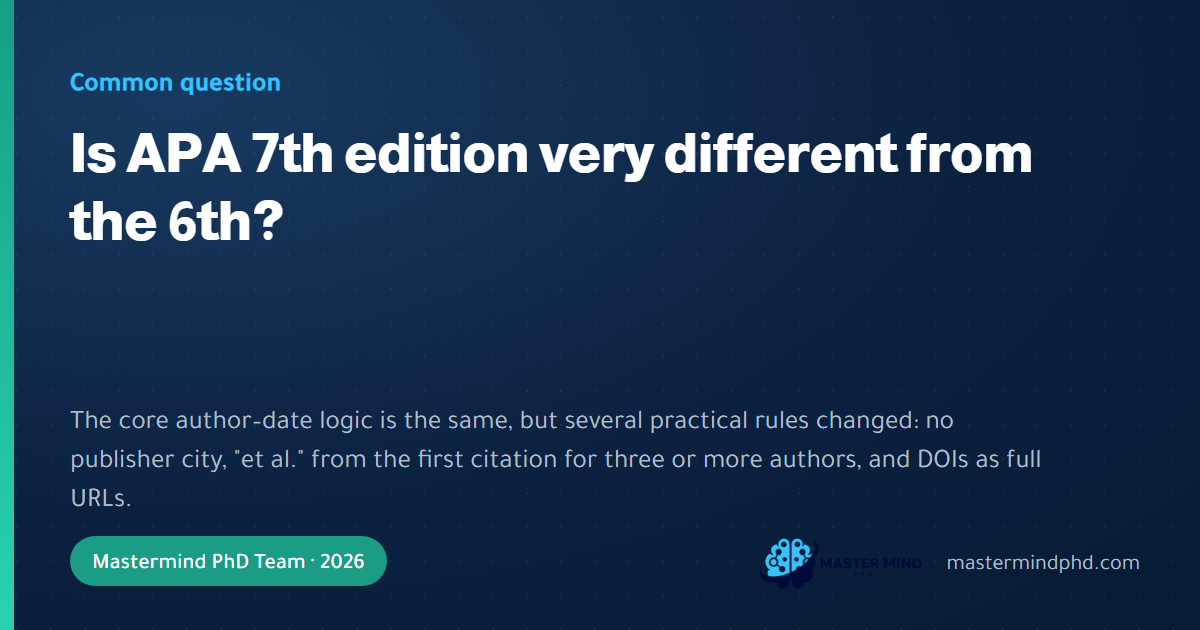
The core author–date logic is the same, but several practical rules changed: no publisher city, “et al.” from the first citation for three or more authors, and DOIs as full URLs. Updating these points is usually enough to convert your habits.
Do I need a page number for every in-text citation?
No. A page number is required for direct quotations and recommended when you point to a specific passage. For a general paraphrase, author and year are sufficient under APA 7th edition citation.
How do I cite a source I found quoted in another work?
Cite the original author in text with “as cited in” the source you actually read, and include only the source you read in your reference list. Find and read the original wherever you can.
Can a reference manager do APA for me automatically?
It automates most of the work, but it makes errors from imperfect source data, so always check the output against the official rules. Tools speed up formatting; they do not replace proofreading the references.
Where is the official APA 7th edition guidance?
The APA Style website publishes free guidance and examples, and the *Publication Manual* (7th ed., 2020) is the authoritative reference. Follow any additional rules your faculty specifies on top of the standard.
Sources
- American Psychological Association. (2020). Publication Manual of the American Psychological Association (7th ed.). https://doi.org/10.1037/0000165-000
- American Psychological Association. APA Style. https://apastyle.apa.org
- Purdue Online Writing Lab. APA Formatting and Style Guide (7th Edition). https://owl.purdue.edu
- Mastermind PhD. Pricing. https://mastermindphd.com/pricing/
Sources last checked: November 2026. This article is general educational guidance and does not replace your university regulations or your supervisor’s instructions. How we prepare our content.