

Your thesis results are ready and your supervisor says “this could be a conference paper”. Where do you send it, and how? For many master’s students, a conference is a more realistic first publication than a journal: review is faster, the format is shorter, and presenting brings feedback from people who work on the same problem. This guide explains the formats you can submit, how to find a suitable conference, how to tell a real one from a predatory one, the seven steps from call for papers to presentation, and how a conference paper relates to a later journal article.
This article is part of our guide How to Write a Master’s Thesis by the Mastermind PhD team and relates to our Journal Article support service. Sources last checked: November 2026.
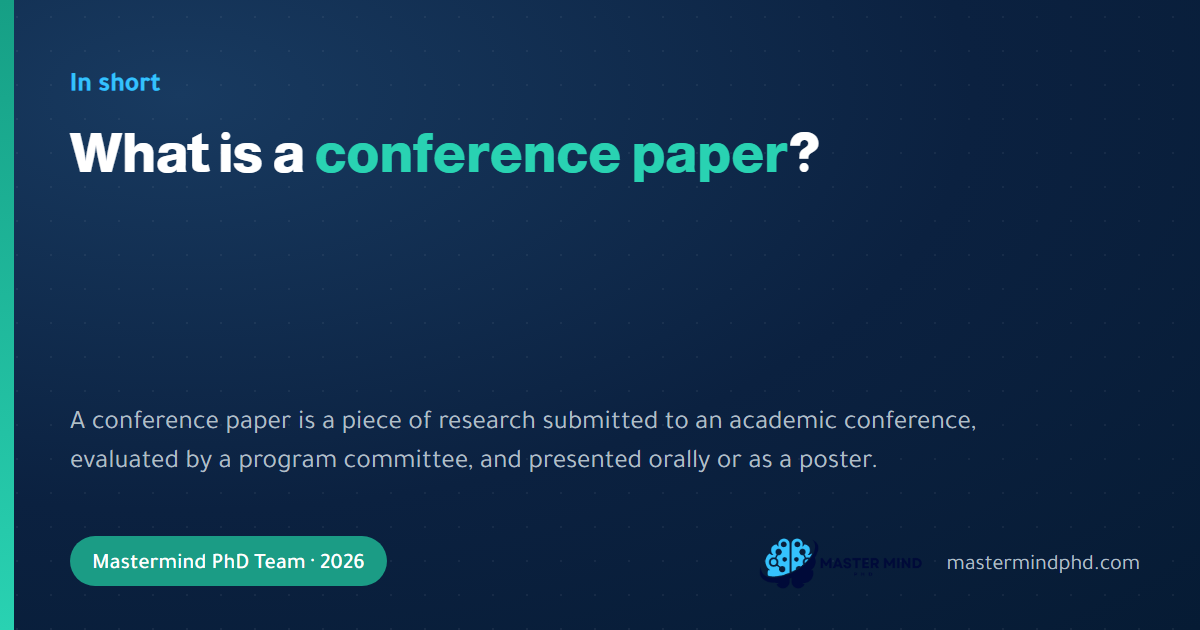
What is a conference paper? A conference paper is a piece of research submitted to an academic conference, evaluated by a program committee, and presented orally or as a poster. Depending on the field and the event, it may be a short abstract, an extended abstract of two to four pages, or a full paper published in proceedings that are indexed in databases such as IEEE Xplore or the ACM Digital Library.
Why should a master’s student submit to a conference?
- Speed. A conference has a fixed decision date, usually a few months after the deadline, so you know where you stand before graduation.
- Feedback. Reviewers and the audience test your argument before you try a journal.
- Visibility. A presented paper with a DOI strengthens a PhD or job application.
- Network. You meet researchers who may later become supervisors, co-authors or employers.
The value differs by field. In computer science and engineering, full papers in selective conferences count as major publications. In most social sciences, health sciences and humanities, conference presentations are a step toward a journal article rather than the final output.
Which formats can you submit?
| Format | Typical length | Reviewed as | Best for |
|---|---|---|---|
| Abstract only | 250 to 500 words | Topic and clarity | Early results, social sciences and health |
| Extended abstract | 2 to 4 pages | Method and preliminary findings | Work in progress |
| Full paper | 6 to 12 pages, set by the template | Complete study | Computing and engineering proceedings |
| Poster | One page plus abstract | Topic and results | First presentation experience |
| Student or doctoral track | Varies | Research potential | Students with feedback needs |
Lengths vary by event, so always follow the call for papers and the official template.
📱 Ask about journal publication support — Help choosing a suitable journal and meeting author guidelines, with a Turnitin report before submission.
Where can you find a suitable conference?
Start with the reference list of your thesis: the conferences where the papers you cite were presented are the ones your community attends. Then check:
- Your field’s learned societies, which usually run an annual conference with student rates.
- Your supervisor and department, who know which events are respected locally.
- Ranking lists where they exist. In computing, the ICORE (formerly CORE) portal ranks conferences as A*, A, B or C; its 2026 edition covers 825 ranked venues.
- Student-specific events, such as student research competitions, graduate symposia and doctoral consortia attached to larger conferences.
Prefer a regional or student event with a real program committee over a large unknown conference that promises indexing in every database.
How do you check that a conference is legitimate?
Predatory conferences charge high fees, accept almost everything, and publish proceedings that nobody reads. The Think. Check. Attend. initiative publishes an 18-question checklist. The most useful questions for a student are:
| Area | Questions to ask |
|---|---|
| Organizers | Do you know the society or association behind it? Have colleagues attended before? |
| Venue and fees | Is the venue clear? Are all fees stated in advance? |
| Committee | Is the editorial committee listed, and have you heard of its members? |
| Review | Is the type of peer review stated clearly? |
| Proceedings | Is it clear where the proceedings will be published and which indexing services are confirmed? |
| Publisher | Is the proceedings publisher a member of COPE, DOAJ or OASPA? |
Warning signs include an unrelated mix of topics in one event, acceptance within days, invitations by unsolicited email, and a program committee with no verifiable names.

What are the seven steps from call for papers to presentation?
- Read the call for papers. Note the tracks, page limit, template, anonymization rules and all deadlines (abstract, full paper, camera-ready, registration).
- Agree authorship with your supervisor. Decide who is listed and in which order before writing. Our guide to co-authorship with a supervisor covers the norms.
- Cut the thesis down. A conference paper answers one question with one main result. Use the template from the start.
- Submit through the conference system, such as EasyChair, Microsoft CMT or OpenReview, and remove your names if review is anonymized.
- Respond to reviews. If accepted, revise the camera-ready version using the reviewers’ comments.
- Register and pay. At least one author must usually register by a fixed date for the paper to appear in the program.
- Present. Many conferences require an author to present in person or online. IEEE LCN, for example, reserves the right to exclude papers that are not presented from IEEE Xplore.
How do you turn thesis chapters into a conference paper?
A thesis explains everything; a conference paper selects. Work from the results backward:
| Thesis chapter | What to keep in the paper |
|---|---|
| Introduction | One paragraph on the problem and one on the gap, ending with the question |
| Literature review | The five to ten studies closest to yours, folded into the introduction |
| Methodology | Design, sample, instruments and analysis in enough detail to judge validity |
| Results | The one or two findings that answer the question, with one table or figure each |
| Discussion | What the finding means, its main limitation and the next step |
Leave out secondary hypotheses, long descriptive tables and the full history of the topic; they can go into a later journal version. Ask your supervisor to read the draft against the conference’s review criteria, which are usually published with the call for papers.
How much does a conference paper cost, and who pays?
Costs include registration (often with a lower student rate), travel and accommodation. Ask early about funding: departments, graduate schools, learned societies and some conferences offer student travel grants or fee waivers for volunteers. Never pay an extra “publication fee” to an event you have not checked with the list above.
Does a conference paper stop you from publishing in a journal?
Not usually, but the details matter. SAGE’s prior publication policy says that a manuscript based on a conference presentation may be considered if it is unpublished and you still hold the rights, and that a published conference abstract or poster will generally not affect eligibility. A full paper in indexed proceedings is different: many journals expect a substantially extended version and a citation to the conference paper. Check the target journal’s policy before you choose between a full paper and an abstract.
A typical timeline for a master’s student
The scenario below is illustrative, not a rule:
| Month | Task |
|---|---|
| 1 | Choose the conference and agree authorship |
| 2 | Draft the conference paper from the thesis results |
| 3 | Submit before the deadline |
| 4 to 5 | Wait for reviews; continue the thesis |
| 6 | Revise the camera-ready version and register |
| 7 to 8 | Present and collect feedback for a journal version |
📱 Ask on WhatsApp now — 5 years of experience across all disciplines and 14 academic services. Two-stage payment (80/20); revisions are free until supervisor approval, within 30% of the chapter.
Frequently asked questions
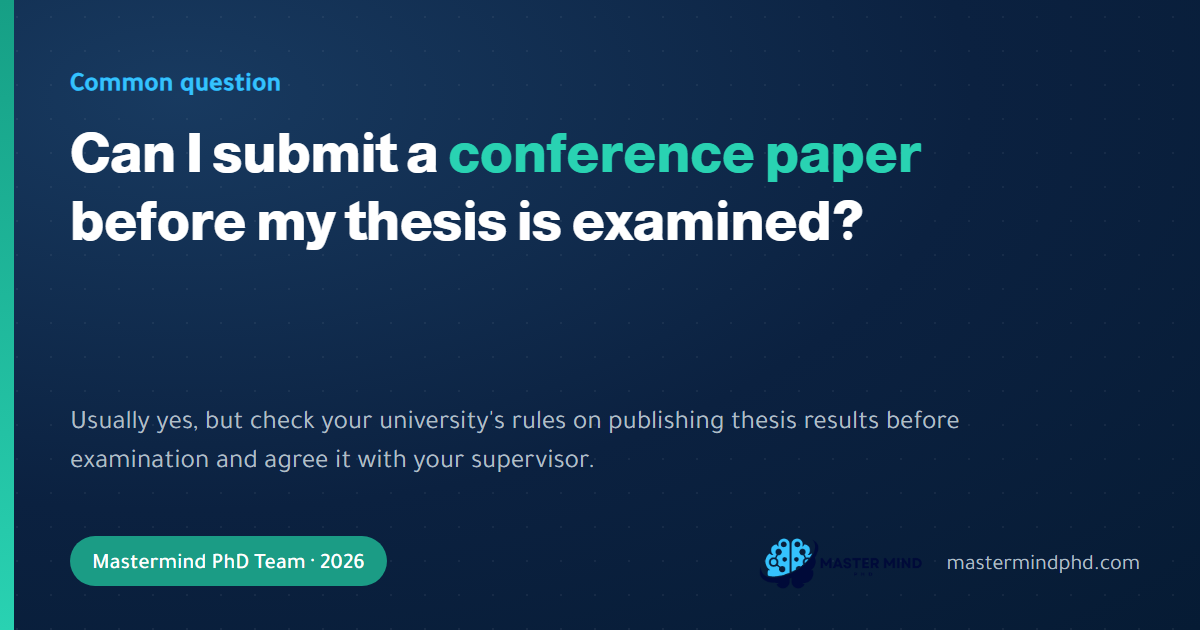
Can I submit a conference paper before my thesis is examined?
Usually yes, but check your university’s rules on publishing thesis results before examination and agree it with your supervisor. Cite the conference paper in the thesis if your regulations require it.
Do I need my supervisor as a co-author?
If the supervisor contributed substantially to the design, analysis or writing, authorship norms say they should be listed. If not, an acknowledgement is appropriate.
What if I cannot travel to present?
Ask the organizers early about online presentation or presentation by a co-author. Papers that are not presented may be removed from the proceedings at some conferences.
Is a poster worth less than a talk?
Posters are reviewed differently but often bring longer, more useful conversations. For a first conference, a poster is a good choice.
Can I submit the same conference paper to two conferences?
No. Simultaneous submission of the same work is treated as duplicate submission and can lead to rejection by both.
Sources
- Think. Check. Attend. Check. https://thinkcheckattend.org/check/ (accessed November 2026)
- IEEE Conference on Local Computer Networks (LCN). Author No-Show Policy. https://ieeelcn.org/Author_NoShow.html (accessed November 2026)
- SAGE Publishing. Prior publication. https://www.sagepub.com/en-us/nam/prior-publication (accessed November 2026)
- ICORE (Computing Research and Education). Conference Portal: Rankings. https://portal.core.edu.au/conf-ranks/ (accessed November 2026)
- COPE Council. (2019). COPE discussion document: Authorship (Version 2). Committee on Publication Ethics. https://doi.org/10.24318/cope.2019.3.3
Sources last checked: November 2026. This article is general educational guidance and does not replace your university regulations or your supervisor’s instructions. How we prepare our content.